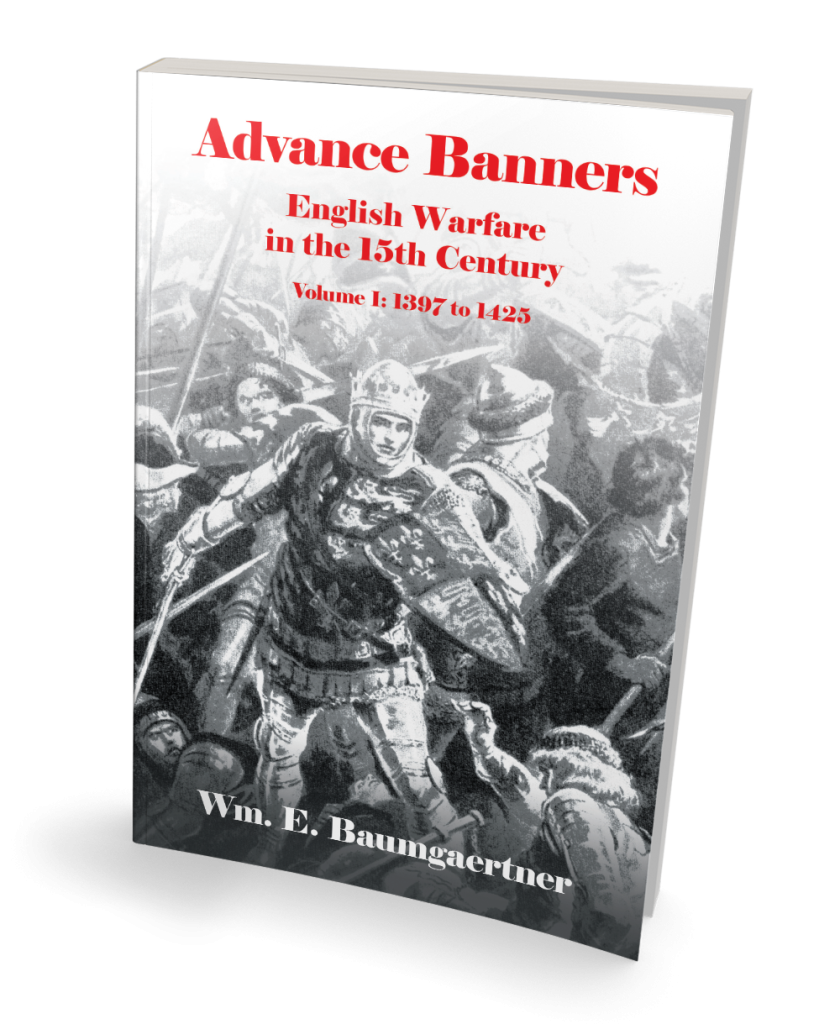
In set battles in the Middle Ages, English commanders almost never yelled “charge” or “attack”. They exhorted their men to move forward against the enemy battle line with the command of either “banners forward”, or “advance banners”. This had significant meaning in England during the Middle Ages.
On each side of the battlefield, each battle line usually had one primary commander, one or more subordinate commanders, and a whole slew of minor commanders – a necessity to keep large bodies of men under control and moving in the correct direction, and to maneuver units during the battle. Each commander rode under one or more of his own distinct battle standards or banners (large rectangular flags). These banners clearly identified who was under them, as they had distinctive familial colors or symbols or arms. An example is de Vere – a banner quartered in red and gold, with a large white star in the upper red quarter; and/or the family battle standard – a blue boar on a tawny field scattered with small white stars. These battle standards or banners told men what location they were supposed to muster around in preparation for a battle, and what banner to follow into battle. At the Battle of Agincourt, Henry V stood under five banners: the banners of the Trinity, the Virgin, St. George, St. Edward, and his own royal banner.
Certain knights, who had proven their valor and cool headedness in battle, could be promoted to “knights banneret”. This entitled them to carry a banner into a battle, rather than a simple knight’s pennant. It also entitled them to recruit other knights and their retinues to fight under their banner.
So, the command to “advance banners”, or “banners forward”, was a somewhat more sophisticated way to tell the battle line to move forward and attack the enemy.